You can read the first 80% of this story for free; if you like it,
you can read the rest for $.79 (payable by paypal or credit card.)
[ Read more about author Andrew Burt
]
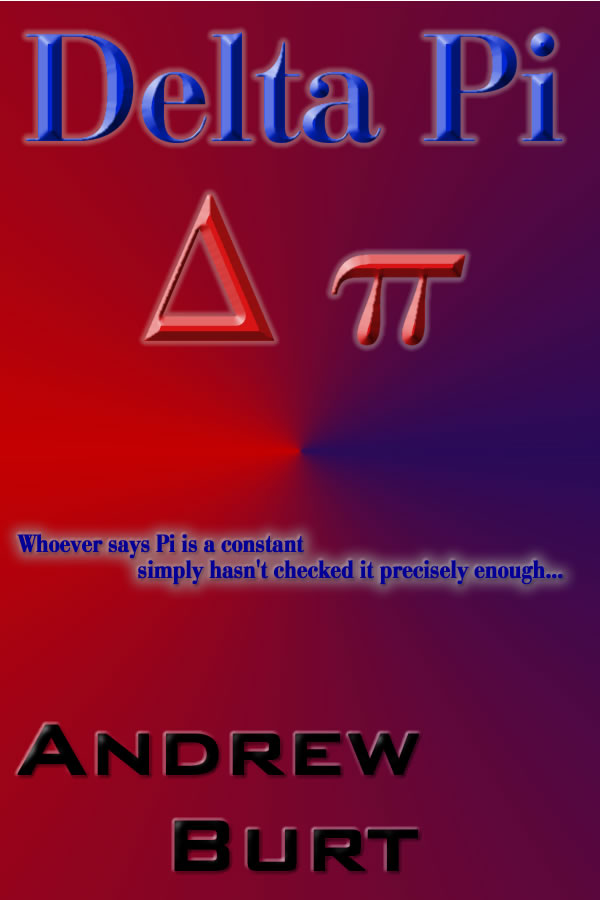
Whoever says Pi is a constant simply hasn't
checked it precisely enough — which may be a
good
thing!
Δ π
(Delta Pi)
by Andrew Burt
Monday, 06/08/2009
(being the date,
and the first occurrence
of the digits 06082009 in Pi,
starting at the 971,051st decimal.)
Kinsey Stafford noticed it--or, rather, the effect of it--in
his office at the Center for Mathematical Studies, Cambridge,
England. His chest tightened and he hung his head in grief: His
program to calculate the deep digits of pi had suddenly crashed.
In a race against time to save his career, he'd just lost precious
months' work.
Monica Ozawa, at the other end of the video link in Kuala
Lumpur, noticed it too. "What in hell was that?" Her program
crashed likewise.
The staff at the Rio superconducting supercollider noticed it,
thousands of miles away from either.
Two small children playing in Mexico City really noticed it as
their cinderblock walls crashed down on them from the resulting
earthquake, an intensity XII on the twelve degree Mercalli damage
index. The media, still in love with the useless Richter scale,
called it as an 8.7. At least two hundred thousand dead, they
reported without emotion.
And a junior high school student noticed it in Fertile,
Minnesota, doing her Intro to Trig homework. Not that she knew or
cared how similar the cosine algorithm in her calculator was to
Kinsey's or Monica's pi routines. She knitted her brows: cos(0.5)
should not equal 1.000000000 as displayed on the screen. She
cleared the entry and retyped, carefully, point, five, cosine.
0.877582562; that looked better. She resumed her calculations, as
oblivious as all the others to the monumental discovery mankind had
just made.
Sunday, 06/28/2009
(Pi, 617,323rd decimal)
Almost a month later, Kinsey was still blissfully unaware of
the role he'd played in the Mexico City carnage. He wasn't cruel
or psychotic; had he known, he certainly wouldn't be running the
program again. He was, however, narrowing his eyes in disbelief as
before.
"Ozawa," he commanded the screen. Oh, damn, the eight hour
time difference--she was going to be pissed off.
"Kinsey?" She craned her neck to check the time. "You forgot
again, didn't you." She yawned. "It's three A.M. This is
Earth-shatteringly important, right?"
His sheepish grin quickly gave way to his natural excitement.
"Sorry, I, uh... Yes. Yes, it is! It's the first time in three
weeks that I've had time to get on T. Rex to check the
Gauss-Legendre-Stafford convergence, and, uh... Earth-shattering,
yes!--sorry, I'm rambling--been up two days--paper deadline--tenure
thing--look, have you compared your recent results from your hacked
Borwein with your old ones?"
Her eyes were closed as she talked, indicating the depth to
which she didn't care. Summing up enormous quantities of ever
shrinking fractions as the total homed in on some value, like pi,
wasn't the most glamorous work, but she took her shared research
into rapid convergence algorithms as seriously as Kinsey. Though,
having no career-ending tenure decision riding on it, she didn't
feel compelled to work twenty hours a day on it. "No, sorry, we
don't have the luxury of a dinosaur system like you society
boys."
She smiled at his grimace. She enjoyed poking fun at his
swellheaded employers--having chosen not to accept their offer four
years earlier, instead opting for the slightly less impressive, but
much less stressful, world of Bell-Matsushita Lab's Southeast Asian
site. He might have access to T. Rex, a "DiNosAur" DNA-based
supercomputer to play with, but she hadn't taken to the high
intensity life that the Kinsey Staffords of the world thrived on.
With only an old Hyper-Cray, she'd still published twice as many
papers as Kinsey since she'd left CMS, a sore point she impishly
played on.
He was far too serious lately, with only six months until the
curmudgeonly faculty decided his tenure, and it was not looking
good. He was brilliant, but never satisfied enough to commit to
publication. His algorithmic work was make or break--and 'break'
from the CMS meant he might as well look for a job as a dishwasher:
CMS only took people they knew they would keep, but not being kept
was a scarlet letter. She didn't have that same pressure, which
made collaboration with him difficult at times. Like now.
"Besides, I didn't restart it until last week; it hasn't reached
where it was when it bombed. It's only at a couple trillion digits
or so."
"Go check it!" His head bounced energetically, eyes wide.
She looked at him sourly; he was far too awake for her tastes.
"Can't this wait until our usual link time, tomorrow?"
"No! Right now! Listen, my GLS is at about twenty
trillion--and--and--it's changed! Can you say 'Nobel
Prize'? My birthday, the digits used to be around fifty million,
now they're at two hundred million! And the earthquakes, this must
be what's causing them!"
Talking through another yawn, she managed, "Yu-ih nah may-ing
en-ih sense."
"Pi, damnit! Pi! It's changed!"
He paced around his office irritably for the half hour it took
her to reach her office and call back. Why didn't she work closer
to the office? Or have a cot in the office, like he
did. Much more efficient that way; he'd have to suggest it.
Monica still looked baggy-eyed, but mentally she was wide
awake, almost panicked when she finally called. "It can't be. Ok,
what do you have at, say, nine hundred billion?"
"Drum roll please! Starting at the nine-hundred-billionth
decimal place of pi we have: 11597--"
"No, I have 61630."
"Exactly! And I know you're going to say it's a bug in your
program, or mine. It's not. What did you have before? I had,
mmm,"--he panned the display on the screen--"38072."
"Hang on, I'm looking."
He drummed his fingers loudly in anticipation.
"Ok, I had 38072 also."
"So? You see?"
"Well, ok, so somehow both our programs became
corrupted. Or it could be hardware."
"Oh, c'mon, Monica. I wouldn't call you in a tizzy at three
A.M. if I hadn't been thorough, you should know me better than that by now." He gave her a reprimanding grin. He could
smell tenure. Better: A Nobel prize. "I've tried five algorithms
on four different machines, all twenty combinations. And they all differ, and--get this--they all differ at different
places! They all agreed, every time, up to about a hundred billion
decimals. The majority agreed out to five hundred billion. In two
cases, two agreed out to nearly a trillion. And those two pairs?
They agreed on two different values! That's
why the programs crashed."
Monica looked distressed. "And you say the timing of your
spikes in pi coincide with the earthquakes?" She imagined the
seismographs spiking alongside some curve of Kinsey's. She felt
the burden of millions of deaths, past and future, pressing on her
chest. "Are you sure?"
"Yes, yes," Kinsey waved it off, and straightened up--in his
exuberance he'd leaned forward until his face almost touched the
screen. He adjusted his tie. "Like it or not, pi has
changed. Not only changed, it's fluctuating."
Thursday, 08/06/2009
(Pi, 805,788th decimal)
The core of the earth belched. The number of earthquakes had
been increasing, in both frequency and severity. "Just random
variations," the geologists said, and joked on the morning talk
shows that if they weren't, the quakes would rip the earth's crust
apart in less than a year. And of course, they quipped, that
wasn't going to happen, was it?
Some quakes occurred so deep that they were mere trifles by
the time they reached the surface, but not all--this time, bubbles
of indigestion bumped the Pacific plate near Wake Island, causing a
series of rapid seaquakes that flattened many a fish unfortunate
enough to be near the landslides at the rocky bottom. Few people
noticed. Instead, they noticed the tsunamis smashing Tokyo and
Honolulu. The media endlessly played the miraculously surviving
video of a family being lofted by a wave and dashed against a
luxury hotel.
The first wave was the worst, carrying the most energy, direct
from the first hiccup on the sea floor. But its siblings followed,
biggest to smallest, like the waves spreading from a rock tossed
into a pond.
The supercollider crew noticed it again. Yet another in their
sequence of experiments using precisely timed collisions of
supercooled particles, immobilized by microscopic black holes--had
failed. Rather, it had succeeded too well, giving results contrary
to the laws of quantum mechanics. One of the MIT grad students on
a summer internship noticed, Davis O'Reilly, even commented (a
little too seriously) on the high correlation of earthquakes to the
experiments--and was summarily shunned as if he were a
superstitious peasant from the Middle Ages.
Kinsey, asleep on his cot, noticed none of it. His programs,
hundreds running on hundreds of systems, all forged ahead, having
been carefully constructed to survive the vacillations in pi.
Monica, however, felt sickened. Her own grandmother had been
in one of the villages. Like some of the other elders, she'd
refused to leave her home. None in the village had survived.
Monica couldn't unglue her eyes from the scenes of carnage.
It wasn't the devastation, though, that made Monica's jaw go
slack as she watched the CNN Disaster Channel, but the pattern the
tsunamis made. The rock-in-the-pond ripple pattern--something
clicked. The pattern was exactly what she'd been searching for:
Ripples, large, then dampened--that was it!
Friday, 09/11/2009
(Pi, 931,656th decimal)
"You still haven't told anyone, right?" Monica asked.
"No, of course not. I'm not ready for the world to label me
the biggest fool since the Indiana Legislature." In 1897, the
General Assembly of Indiana had entertained a bill, backed by the
State Superintendent of Public Instruction, designating pi to be
four. Ever since, they'd been the laughingstock of the
mathematical world, a club Kinsey was in no mood to join.
Monica looked her usual, comfortably dressed self, in contrast
to Kinsey's ubiquitously rumpled, university-dress-code suit and
tie, but her lips were pressed thin, eyes slitted, as she
scrutinized the screen. "And look, here, on August 6th, there's
another huge spike, another rock in the pond, so to speak. Both
your computations of pi and mine went wild right then."
They'd been running pi calculating programs by the millions,
carefully logging which algorithm, which system, what time, and how
many digits it computed before it disagreed with the "standard"
definition--the ten trillion digit value of pi that had gone
unchanged for years, despite numerous computations, each confirming
its ancestors and computing more trillions of digits. Everyone
agreed there was absolutely no practical use for more
than perhaps a hundred digits of pi. With no more than that, one
could describe any position in the universe within the width of an
electron. Kinsey cared only because it was a popular number to
test algorithms on.
Yet pi had always had a sort of cult following, such as poor
William Shanks, who'd painstakingly calculated 707 digits, by hand,
in 1873. Fortunately he hadn't lived to find his years of effort
had an error at the 528th digit, or so said D. F. Ferguson in 1948,
confirmed by ENIAC when computers had first been applied to the
task in 1949.
Kinsey was daydreaming; perhaps Shanks hadn't made
a mistake after all. No, chances were he actually had, given the
fallible nature of humans posed with tedious tasks. No matter; he
shook the cobwebs from his mind and focused on the screen.
"Yes, yes. If you take each big spike, and
superimpose an exponentially decaying sine wave starting there, on
top of the existing waves--yes, that's it exactly!" The
screen showed the strange, complex ripple pattern and below it, a
sequence of waves. One new, pristine ripple wave starting for each
huge spike in the complex one like a snapshot of a horse race at
the finish. When added together, the heights of the simple waves
exactly matched the complex pattern--the pattern of the
oscillations of precision in pi.
"But I still say we throw out the August 6th data point, where
that cheesy Machin algorithm said pi was eighty-seven thousand something." He snorted.
"No, look, that's dead center on that huge spike." She shook
her head. Maybe nobody would believe them, but it wouldn't matter
whether the crazy value was left in or not. "They dampen out so
quickly, it's amazing we had any that show a difference
anywhere inside the first million decimals. But we do--we can't
ignore them."
"Ye-esss," he protested, "but they'll think we're lunatics to say, 'oh, by the way, on August 6th, 2009, we
established an accurate measure of pi to be, yawn, eighty-seven
thousand, five hundred ninety-one point zero eight seven,'" he said, emphasizing the most trivial digit for
comic effect. "No, we can't announce this until we can describe
its exact behavior so others can easily reproduce it."
"That's true," she added, "and maybe it'll go away by then and
we can forget it ever happened."
"Hmph." He rubbed his eyes with both hands. He needed to
pull something out of this to publish, and he'd
spent--wasted--three months now chasing this bouncing pi thing.
"Umm. While we're on the subject of really crazy thoughts. You
know how the wavelength seems so random, sometimes dampening very
quickly, sometimes slowly, without regard to the amplitude?" They
both looked at the arrays of "pure" ripple patterns, clearly
displaying the issue: They all dampened out to a nearly straight
line, but in wildly varying lengths of time; some flattened to zero
almost immediately, some took quite a while.
"Yeah, did you find something?"
"Well, maybe. I let it run a multi-way correlation with every
variable I could find. Only one came up significant." He frowned,
skeptically.
"And? And?"
"Er, it doesn't make any sense, but... ok... it was nk, the number of observations. The more observational test
runs we do, the longer the value of pi wobbles in the early
decimals. The fewer test runs, the sooner the variation drops to
the distant digits."
She shook her head. He was grasping at straws. She knew the
feeling. Maybe she should suggest that she could put in a good
word for him at the Labs, and he could come work in Kuala Lumpur if
he wanted. On the other hand, she couldn't stomach him having a
cot next door; or, worse, if they ended up sharing an office...
"No, that's because you have more points, to plot a more accurate
curve."
"I thought so too, but it's not. The wavelength is
wider with more observations, even at an absurdly tight 99.99%
confidence level. It's truly bizarre. I've never heard of
anything like that."
Monica's eyes grew wide. "Wait a minute--I have!" She
swallowed hard. "What do you know about quantum mechanics?"
Friday, 10/02/2009
(Pi, 551,412nd decimal)
Although nobody among the supercollider staff had taken
O'Reilly's comment seriously, they nonetheless regretted that he'd
said it. He regretted it now, too. Rebuffed, he'd half-jokingly,
half-vindictively mentioned it in an on-line chat session. Now,
thanks to some self-appointed vigilante lurkers who overheard,
there was an organized protest outside the lab, demanding they shut
down their "dangerous," "defense-related," "weapons research"
experimentation. "No more quakes." "End cruelty to particles."
"'Nuke the black hole bomb', indeed," the lab's director said
as he stared sidelong out the window, holding the blinds out just
enough to see. He sighed. Black holes might be useful for many
things, but if anyone were working on making weapons out of them,
it certainly wasn't the Rio collider people, as their precariously
low funding showed. Maybe they should be, mused the
director. "So, we're all agreed, reluctantly?" The group murmured
their assent, heads nodding slowly; when the National Congress
jangled the purse strings, they listened. "All right then. Black
hole related research is shelved for sixty days minimum, and we're
closed for business until further notice."
Kinsey knew Monica would really be pissed this time. She'd
specifically told him not to disturb her, that she
wanted to be fresh for the news conference tomorrow. Then again,
she might be pissed if he didn't tell her as soon as possible. He
teetered on the edge of indecision. "Arrrgh! Oh, to hell with it!
Ozawa!" The screen blinked, in dialing mode.
"Damnit, Kinsey! I told you--"
"I know, I know, but... look!"
He pulled up the oscillation map of pi that they'd perfected
for tomorrow's demonstration. All the recent patterns showed no
variation. Pi, the constant, was constant again. Flat lines
filled the screen instead of ripples. "I don't know about you, but
I don't think I want to demonstrate the 'conclusive' evidence of
the variability of pi when the little bugger won't vary."
"Oh, shit!" She slumped back into her pillows. "Well, maybe
it'll resume by tomorrow. I'll call you when I get up." She
signed off.
He paced the room, wondering what career move to make now that
he was sunk.
"Kinsey! Kinsey, wake up!" He'd left his end of the
connection open, so her call re-entered the old session; Monica
could see his head resting on the keyboard. "Kinsey! I figured it
out! Wake up!"
He tilted his head back to see the screen. "What? Oh, must
have dozed off. Up three days. What's new? What time is it?"
Suddenly he remembered, he jerked upright--"Oh God, the press
conference!"
"Relax, that's not for four more hours. If we want to go on
with it. We won't have anything to show, and I can tell you
why."
"Go on..."
She teased him with suspense: "And, it explains, exactly, the amplitude spikes where each new ripple
begins."
"Get on with it, will you?"
"Earthquakes." She paused, for dramatic effect. "And black
holes, and supercolliders." Another pause, to see if he'd made the
connection himself.
"Will you please get to the point!"
"Ok! Ok! Sit back and get comfortable. First, all the
earthquakes--you hopefully noticed there has been a sudden
unexplained increase in the number of them recently, and a lot of
particularly huge ones?"
"Oh, I guess so. I don't pay attention to the news. But--ok,
stipulated."
"Then you probably didn't notice the brouhaha in Rio de
Janeiro about the supercollider. The salient facts are: They're
conducting experiments smashing tiny particles into each other, as
colliders do. What's unique is they've got the particles down to
absolute zero when they collide. They use magnetic fields and some
sort of layers of microscopic black holes of diminishing size, the
larger ones guiding the smaller ones; extremely precise. At the
lowest level, a lattice of teeny tiny ones holds a single particle,
and holds it absolutely still--at absolute zero, in fact. Then
they accelerate the lattice toward another one. The two lattices
carefully slide through each other, their mutual gravitational
effects keeping the particle extremely precise in spatial position,
so that the two particles inside collide dead on, still at absolute
zero with respect to the lattices.
"So: Note that they have the energy of the particles at
nearly zero, with respect to the lattices.
"Next, the timing. The black hole 'tunnel' is precisely
aligned, so they know the timing exactly. So: Note they now have
both the time, and energy, of impact precisely known.
"Here's the killer part: Heisenberg's Uncertainty Principle.
You know it?"
Kinsey shook his head. "Just the name. I'm math, not
physics, remember?"
"Ok. Most people think of it as saying you can't know both
the position and momentum of a particle exactly, that the more
precisely you know one, the less you know the other. Well, the
same thing applies to time and energy. The usual way to express
that is delta-t delta-E is greater or equal to h-bar over two."
She wrote on the screen, t E r /2. "This says the uncertainty in
the knowledge of time multiplied by the uncertainty in the
knowledge of energy is greater or equal to /2. And, hold onto
your hat, h-bar is h, Plank's constant, over two pi. Do
you see it? If you isolate pi, you have pi r h/(2 t E)."
Kinsey rubbed his cheek in contemplation. "You're saying, if
I understand this, that these physicists got the uncertainty in
both time and energy very small, yes? So small, that it no longer
could be greater than what we normally consider a constant value,
so one of the constants had to change?"
"Yes! It makes perfect sense if you think about one thing:
What is pi, anyway? What does it mean?"
"The ratio of the circumference of a circle to the
diameter."
"Right--it's a physical value, relating to the
shape of the universe. When they smashed those particles together,
instead of the energy and time uncertainties being high, they'd
accidentally--at least, I think it was accidentally--constrained
them so they had to both be low. This pushed the uncertainty
somewhere else, into the curvature of the universe. All of
mathematics shudders to remain consistent. In theory, the value of
every fraction has to bounce to keep in step."
With a mocking blandness, as one might announce that the sun
was expected to rise yet again tomorrow, he said, "And that's what
caused the earthquakes, the changing curvature of the universe? Of
course."
"No, not actually. That would be consistent within itself,
i.e., everywhere changing the same way. So, even though pi
changed, it normally wouldn't matter. No, we caused the
earthquakes."
"What's that now?" Kinsey had a smile of severe disbelief on
his face.
"It's the Uncertainty Principle again. One implication of it
is that the act of measuring something very precisely alters the
uncertainty in other types of measurement. We were measuring pi.
That altered other measurements of it, in effect, altering pi
itself."
He threw up his hands. "Now I know you've gone off
the deep end."
"No, wait, hear me out. Say that's true, then we'd see this
all the time, right? Well, what if we don't, because the
uncertainty in pi is normally so small we never detect it? What if
the uncertainty is normally way past the trillions of digits we've
measured; say it was in the trillion trillion trillionth place, or
somewhere so far down that it would strain the limits of
computation even to store the digits? Not that it is, but it could be. That would be consistent, i.e., some formulation
of the Uncertainty Principle involving the magnitude of numbers we
can actually physically compute. Remember, when it comes to
irrational numbers, by definition, we already know we can never
compute them exactly, we approximate them out to some
number of digits that works for whatever purpose we need, or we use
a symbol for them, like pi, e, and so on."
He pursed his lips. "Something like saying, irrationals are
not rational simply because they're a kind of rational that would
require more digits or other storage space than is physically
possible in the universe? That we consider them to have an
infinite number of non-repeating decimals only because (a) we can't
store all of them and (b) they're changing anyway? And that the
actual amount of storage space in the universe implies how much
variation there could be in a given value? Infinity is just 'more
than we can compute'? I'll be damned, but it almost makes sense.
It would imply there's a maximum integer, after which the entire
universe would be unable to store a representation for anything
larger, but... I don't know, that's pretty queer. But you still
haven't explained the earthquakes."
"That's easy, from those assumptions. Here we are, measuring
pi--and make no mistake about it, the formulas we use, they do
measure it, or attempt to, exactly--and then there are these
physicists who push off a huge uncertainty onto it. We bump into
that uncertainty, yet not just once, but multiple times,
once for each running program. The first earthquake happened when
we were both running our algorithms, and we suddenly pinned the
universe down to two values of pi, both valid; something
else had to give. I don't know what, but I'm guessing
something magnetic, which affected the Earth's core, causing, hell,
I don't know anything about geophysics, but some kind of burp in
the core. I'm thinking it's localized, perhaps around the midpoint
of the triangle formed by the three events. Pi may vary with
distance from the events, and at the intersection it gets into a
paradox. I don't know what caused it, but I do know that the timings all match up.
"I called down to the lab and got a schedule of when they ran
that experiment. It coincided with every one of the five recent
catastrophic earthquakes, plus the sixty or so others that were too
deep to be noticed except by seismographs, but had as much energy.
And the severity of the earthquakes coincided with the
number of simulation programs we were running, and how
far down into pi they were. Look for yourself." She displayed a
graph, a logarithmic curve with a stripe of data points almost
right on it above "two," looking like the profile of a 40's Chevy
with a hood ornament. It sliced right through dozens of other
points scattered off to the right, values from where they'd been
running hundreds of simultaneous programs: A very precise fit.
"The more programs we run, the worse the earthquakes. But, you can
see it's pretty bad just at two."
He rested his chin on his hands, elbows on the table.
"Euclid. Newton. Gauss. Stafford and Ozawa. We'll be famous
for the entire rest of civilization. My God. I'd say the press
conference is back on!"
She didn't look as joyous as he expected. In fact, she looked
downright disconcerted. "Try this one. Einstein. Atomic Bomb.
Even though he did nearly nothing to produce it, he's associated
with it in some almost infamous way. I may not be an outspoken
peace activist like he was, but I sure don't want this
on my head."
He looked puzzled, eyes searching around the room as he tried
to intuit what she was suggesting. Finally: "Damn. I see what
you mean."
She nodded knowingly.
"But," he continued, "we don't know that anyone could learn to
target it and send earthquakes anywhere they want; though I admit
just the underlying disruption that caused the quakes, whatever its
nature, probably has military uses." He shrugged. "I don't see
that it matters. We can't sit on a fundamental discovery in both
mathematics and physics. We can't forget it ever happened.
Someone else will re-discover it. We might as well get the
credit." In fact, he needed the credit. Weapons would
always be built on top of harmless scientific discoveries; he
couldn't be held responsible.
Monica's ethics ran deeper; she couldn't erase the images of
small crushed bodies in Mexico City. "So, what do you
want to announce at our press conference? We've found out how to
alter the curvature of space, now be good and don't mess around; in
particular, don't make a weapon out of it? And please forgive us
for accidentally killing thousands of people, but we'd like to kill
a few more while we validate this theory? You don't even know what
the potential is--who's to say some brainless twit wouldn't wipe
out the whole planet just playing with it?"
She had a point. Of course she had a point. Several. All
very valid. And if he accepted them, it meant the end of his
career. No, they were scientists. They had a duty to inform the
world. He had to persuade her, counter her arguments about the
millions they'd already killed, injured, and made homeless. He had
to get tenure.
They argued and argued until, moments before they would go
live on the video press conference, Kinsey shouted "Eureka!"
Friday, 12/21/2009
(Pi, 932,401st decimal)
The spin doctors at Bell-Mat had...
Copyright © by Andrew Burt
.
All rights reserved unless specified otherwise above.
--That's the first 80% of the story.
To read the rest of the story for $.79, please click below, thanks!
(Once you've paid for it you can re-read it any time.)